As moviegoers, and more broadly as people, we tend to think of the word “ambition” in a positive vein. To say a movie has ambition is to say it has purpose; to say it has moxie is to say it breaks some new ground.
On the flip side there are those seen as too ambitious, directors who maybe bite off more than they can chew. Paul Thomas Anderson, in his 1999 feature Magnolia, dances with this question almost as an operating procedure. Over the course of three frantic, uneasy hours, Anderson challenges you to see how many moviemaking rules he can flout before you roll your eyes, how much unfiltered emotion you can handle before you (along with his characters) break.
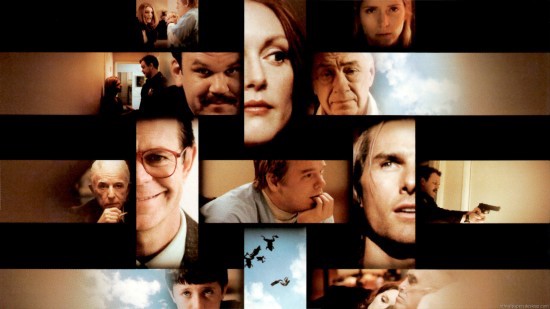
Magnolia tells of a tangled web of characters, each in some way alone, each with some link to a Hollywood television studio that serves as the film’s nexus. There’s the aging quiz show host who’s diagnosed with cancer and forced to reckon with his past, including his disgruntled, cocaine-addicted daughter. There’s the ailing studio executive who on his deathbed seeks out his estranged son, a dating advice specialist played by a downright maniacal Tom Cruise. And beyond these family ties there are secondary players: a cop searching for love; a former quiz-show champion searching for meaning; a quiz-show wunderkind contemplating his existence.
Somehow, over the course of one long day, their paths cross. But the plot — unwieldy and at times surreal — takes a secondary role here. At its heights Magnolia is a deft character study, exploring the decisions we later regret, the lies we tell ourselves to stay afloat, the ways in which we isolate ourselves.
Read more at CineNation.
 Evan Klonsky